July 2026
AI in customer service, without losing the customer
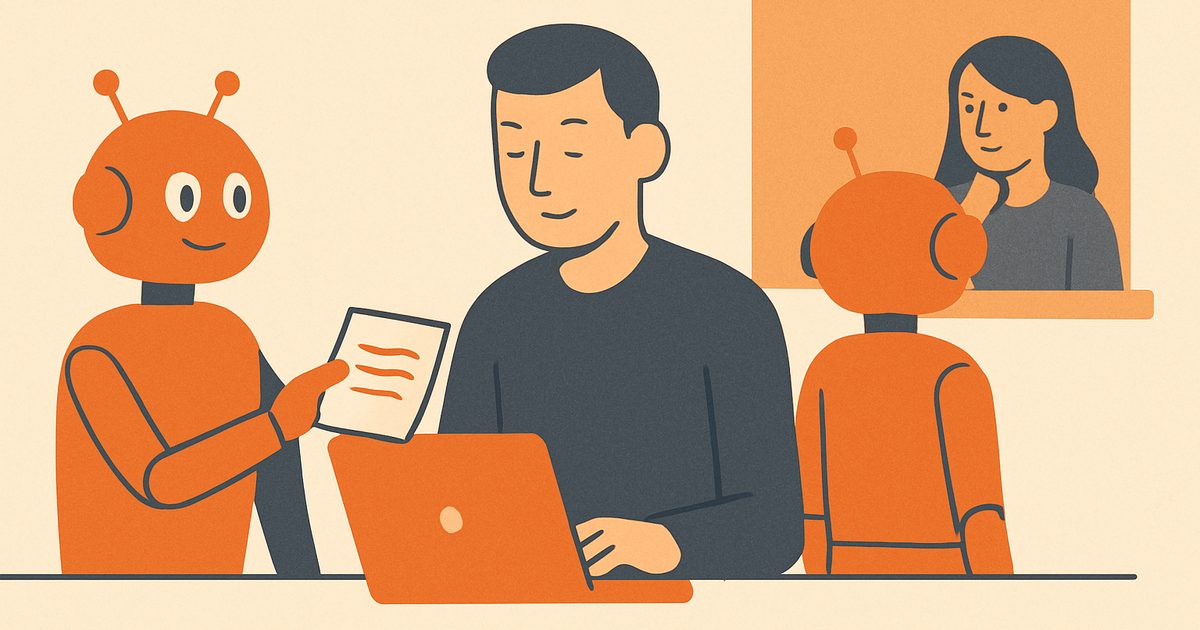
Most advice about AI in customer service is written for companies that have a support department. If you are two people answering email between other jobs, the question is not which model to buy. It is simpler, and harder to dodge: does this make the person waiting for an answer feel better or worse?
Nobody asked what is in your stack
Someone writing to support does not care whether a model drafted your reply, and they will never ask. What they want to know is that their message reached somebody who can actually fix the thing, and roughly when that will happen. How you get there is your problem, not theirs.
That sounds obvious, and it is the thing most AI rollouts get backwards. The number on the slide is deflection rate, which measures how many people you successfully did not talk to. Nobody who has ever written to support wanted to be deflected.
Point the tool at your team, not at your customer
There is a clean line running through all of this. AI that helps the person answering is nearly always fine. AI that stands between you and the customer is where it goes wrong.
On your side of the line: summarising a thread that has run to forty messages, so whoever picks it up is not replying half-informed. Working out which of last night's emails is from the customer who is genuinely stuck. Drafting something a person then rewrites. Your customer experiences none of it directly. They just get a better answer, sooner, from someone who clearly read what they wrote.
On the other side is software answering unsupervised, where the person receiving it has no idea whether their problem was understood or simply filed. Same technology, completely different thing to be on the end of.
Never make someone prove they deserve a human
If you do put something automated in front of customers, the way past it should be one step and it should be obvious. Not buried, not conditional on rephrasing the question, not gated behind reading a suggested article first.
What people hate is not the bot. It is the loop. Everyone has been through the version where the same article comes back a third time, the contact link is nowhere, and the only options left are giving up or complaining somewhere public. By the time a customer has typed "agent" twice, whatever you saved on that ticket is gone, and you have taught them something about your company they will remember for longer than the answer.
Say when it is a machine
Do not give the automation a first name and a friendly photo. People work it out anyway, usually within two replies, and the moment they do, every message before it gets reread as a trick. A small annoyance turns into a question about whether you are straight with them generally.
Saying plainly that a reply is automated, and showing how to reach a person, costs nothing. It also buys patience when the automated answer is only nearly right, because the customer knows what they are dealing with and knows there is a way through.
Fast is not the same as respectful
Instant replies are the easiest thing to sell and the easiest thing to get wrong. An immediate confident answer to a question the customer did not ask is worse than a reply tomorrow morning that actually solves it. People will wait if they believe the wait is going somewhere.
This is where a small team has the advantage. You cannot compete on coverage and you do not need to. A real person who read the message and fixed the problem is the thing large support organisations spend a great deal of money trying to imitate.
Most of what you want is not AI anyway
Look at what people actually ask for when they say they want AI in support. An acknowledgement so the customer knows the message arrived. Tickets that get an owner without anyone assigning them by hand. Something that flags a ticket about to miss its target, or one that has gone quiet for a fortnight, or one that is plainly spam.
None of that needs a language model. Those are rules. They cost nothing per use and they behave the same way every time, which is what you want from something acting on your behalf while you are asleep. Before paying for AI on top of a plan, it is worth checking how much of what you wanted was automation you could have had anyway.
Where we landed
AllMy Support summarises ticket threads, on demand or automatically for long ones, on a credit allowance included in the plan rather than a separate AI bill. That sits on our side of the line. It helps whoever is answering, and your customer never needs to know it exists.
We do not put an agent in front of your customers. At the size we build for, one person who needed help and did not get it costs more than the replies it would have saved. If a bot on the front door is what you want, we are not the right tool for you, and there are good ones.
The measure was never how many conversations you avoided. It is whether the person on the other end came away thinking someone was actually trying to help. You can see the rest of what we built on the features page, or read how the shared inbox and the knowledge base work together.